
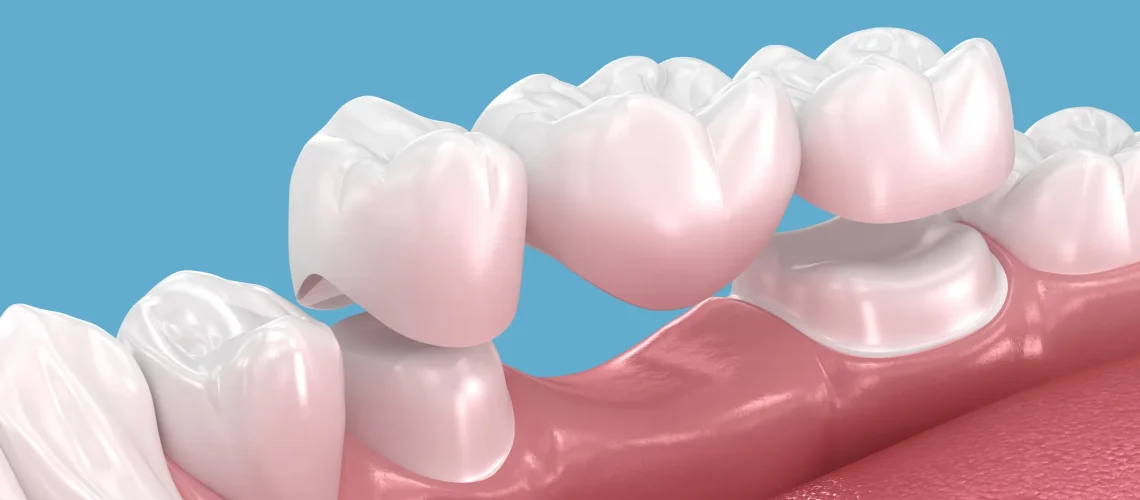
If you have a missing tooth and someone has mentioned a dental bridge as the solution, it is worth taking a step back before committing. A bridge can seem like the straightforward choice, and for certain situations it may be appropriate. But for most patients, there is a better option available that does not require sacrificing the healthy teeth next to the gap, does not allow the jawbone to continue disappearing, and does not need to be replaced in a decade.
At Texas Center for Oral Surgery and Dental Implants, we see patients regularly who were told a bridge was their only option and discovered during a consultation that a dental implant was not only possible but clearly the stronger long-term choice. This post explains what a dental bridge actually involves, what the trade-offs are, and why an implant is usually what we recommend instead.
What Is a Dental Bridge?
A dental bridge is a fixed restoration that spans the gap left by a missing tooth. It works by anchoring a false tooth, called a pontic, to the natural teeth on either side of the space. Those neighboring teeth, called abutment teeth, are permanently drilled into and fitted with crowns that hold the bridge in place as a single connected unit.
It is cemented in and does not come in and out. From the outside it looks like a row of teeth. That much is true. But what happens structurally to get there is something patients deserve to understand fully before agreeing to it.
The Trade-Offs Patients Often Do Not Hear About
Healthy Teeth Get Permanently Altered
To place a traditional bridge, the teeth on either side of the gap must be ground down significantly to accept crowns. These are often perfectly healthy teeth that have never had a problem. Once that enamel is removed, it is gone. Those teeth will require crowns for the rest of the patient’s life, whether or not the bridge ever causes a problem.
If the bridge eventually fails, develops decay at the margins, or needs to be replaced, those abutment teeth are caught in the middle. You started with one missing tooth and now three teeth are involved in the problem.
The Bone Underneath Keeps Disappearing
When a tooth is lost, the jawbone beneath it begins to break down. The root of a natural tooth stimulates the bone and keeps it healthy. Without that stimulation, the bone resorbs over time.
A dental bridge fills the visible gap, but it does nothing to address what is happening below the gumline. The pontic sits on top of the gum, not anchored in the bone. That bone loss continues underneath, which over years can affect the way the bridge fits, the way the face looks, and what treatment options remain if the bridge eventually fails. Cleaning beneath the bridge also requires more than standard flossing, and when that area is not maintained consistently, the risk of decay and gum disease at the margins increases. There is a structural concern as well. Two abutment teeth are now carrying the load that three teeth used to share, which increases the risk of fracture over time. That risk is meaningfully higher when either abutment tooth has had a root canal, since root canal treated teeth are more brittle and less able to handle that kind of sustained force.
Bridges Are Not a Permanent Solution
Most traditional fixed bridges need to be replaced eventually, or the abutment teeth themselves are now hopeless. When that happens, the abutment teeth have to be evaluated again, new impressions taken, a new bridge fabricated. The process and the cost repeat.
Patients who choose a bridge thinking it is the simpler, more affordable option sometimes find that when they factor in replacement over the course of their lifetime, the math looks different than it did upfront.
The Cost Argument for a Bridge Does Not Hold Up Long Term
Many patients arrive having already received a quote for a bridge from their dentist. The upfront number is often lower than an implant, and the dentist may have suggested the bridge can be done more quickly. Both things can be true and still be misleading.
A bridge is still a significant investment, typically several thousand dollars. And that cost does not account for what happens when it eventually fails. When a bridge fails, the entire unit is lost. The patient is now without teeth in that area and facing a more complicated situation than they started with, often requiring multiple dental implants to address what the failed bridge left behind. The lower upfront cost can become a much higher long-term cost, with more disruption along the way.
The timeline argument also deserves scrutiny. At Texas Center for Oral Surgery and Dental Implants, we routinely perform same-day tooth replacement for single missing teeth through full arches. Advanced treatment protocols allow us to place an implant and provide a temporary tooth in the same visit in many cases. The assumption that a bridge is automatically the faster path is worth questioning before it drives the decision.
Why We Typically Recommend an Implant Instead
A dental implant replaces the missing tooth at the root level. A titanium post is placed directly into the jawbone, where it integrates with the bone over time and functions like a natural root. A crown is then placed on top. The teeth on either side are never touched.
Because the implant is anchored in bone, it stimulates the jaw the same way a natural tooth root does, which stops the bone loss that a bridge cannot address. It also functions and feels more like a natural tooth because it is self-supporting rather than dependent on neighboring teeth for stability.
For most patients, a single implant replacing a single missing tooth is the cleaner, more complete solution. There are no neighboring teeth to compromise, no bone loss left unaddressed, and no built-in expiration date on the restoration. In fact 95% of implants will still be going strong after 25 years.
What About Implant-Supported Bridges?
When multiple adjacent teeth are missing, an implant-supported bridge can be an appropriate solution. Rather than reshaping natural teeth to anchor the bridge, implants are placed on either side and the bridge attaches to those. This preserves the neighboring natural teeth and provides the bone-stimulating benefit of implants while restoring multiple teeth with a connected structure.
This is meaningfully different from a traditional tooth-supported bridge and worth discussing during a consultation when several teeth are involved.
So When Does a Traditional Bridge Make Sense?
There are situations where a bridge is genuinely the right answer. If the adjacent teeth already need crowns for other clinical reasons, the calculus changes. If a patient has a health condition that makes surgery inadvisable, that matters too. There are cases where bone loss is significant enough that implant placement requires more preparation than a patient’s situation allows for.
We are not dismissing bridges across the board. But we do believe most patients who come in thinking a bridge is their only option have not yet had the full conversation about what is actually available to them. That is the conversation we have at every consultation.
What to Do Before You Commit to a Bridge
If you have been told a bridge is your best option, or if you are just starting to research what to do about a missing tooth, a consultation with a board-certified oral surgeon is the most important next step before making any decision.
At Texas Center for Oral Surgery and Dental Implants, we use 3D cone beam imaging to evaluate bone structure, adjacent tooth health, and the full picture of your oral situation. From there we can give you an honest assessment of what your options are and what we actually recommend for your specific case.
A bridge is a significant commitment. So is an implant. The difference is that an implant is usually the commitment that holds up better over time, preserves more of what you have, and does not pull other healthy teeth into the equation. We want our patients to understand that before they decide.
Schedule a consultation at one of our Dallas-Fort Worth locations in Flower Mound, Denton, Frisco, or Dallas.
Frequently Asked Questions
What is a dental bridge?
A dental bridge replaces a missing tooth by anchoring a false tooth to the natural teeth on either side of the gap. Those neighboring teeth are permanently reshaped and crowned to hold the bridge in place. It is a fixed restoration, meaning it is cemented in and does not come in and out.
Why might a dentist recommend a bridge instead of an implant?
There are legitimate clinical reasons a bridge may be appropriate, including when adjacent teeth already need crowns or when a patient is not a surgical candidate. But many patients are steered toward a bridge simply because the provider does not place implants. Getting a second opinion from an oral surgeon before committing is always worthwhile.
Does a dental bridge damage the surrounding teeth?
Getting a bridge requires permanently removing enamel from the healthy teeth on either side of the gap. Those teeth are then dependent on crowns for life. If the bridge develops problems later, the neighboring teeth are affected as well.
Does a dental bridge stop bone loss?
No. A bridge replaces the visible tooth but does not replace the root, so the jawbone beneath the pontic continues to resorb over time. A dental implant, which is anchored in the bone, is the only replacement option that addresses bone loss directly.
Is a dental implant better than a bridge?
For most patients, yes. An implant replaces the tooth at the root level, preserves jawbone, and does not require altering adjacent healthy teeth. It is also the more durable long-term solution. Whether an implant is right for your specific situation depends on your bone health, overall health, and the details of your case. That is exactly what a consultation is for.
How do I know if I am a candidate for a dental implant instead of a bridge?
A consultation and 3D imaging give us everything we need to evaluate bone volume, the health of surrounding teeth, and what options are realistic for your situation. Many patients who assume they are not implant candidates find out they are after a proper surgical evaluation.