
Dental implants have become one of the most common tooth replacement options available, and that popularity has brought a lot of providers into the space. General dentists, periodontists, prosthodontists, and oral surgeons all place implants. All of them can do it legally. That does not mean all of them should.
Not All Implant Providers Are the Same
When a procedure becomes widely in demand, it attracts providers at every level of experience. Dental implants are no exception. A general dentist who attended a weekend implant course and an oral and maxillofacial surgeon who completed six years of hospital-based surgical residency can both legally offer implant surgery. From the outside, their marketing may look nearly identical.
The difference shows up in the operating chair, and sometimes years later, when complications arise that a more experienced provider would have anticipated.
What Makes Implant Surgery Genuinely Complex
Placing a dental implant looks deceptively simple. A small post is placed into the jawbone, where it integrates with the surrounding bone and eventually supports a crown, bridge, or full-arch restoration. But behind that straightforward description is a surgical procedure that requires detailed anatomical knowledge, accurate imaging interpretation, and the judgment to adapt when things do not go exactly as planned.
Outcomes depend on both patient factors and provider factors, and understanding the difference matters.
On the patient side, bone density and volume, proximity to nerves and sinus cavities, gum tissue health, overall medical history, bite forces, and long-term restorative goals all influence how treatment is planned and executed.
On the provider side, the variables are just as significant. Implant selection alone involves choosing the right size, design, and brand for the specific case. Straumann implants, which our practice places exclusively, are among the most researched and consistently highest-performing systems in published clinical studies. Timing decisions matter too, including when to place the implant, whether additional procedures like bone grafting are needed first, and which grafting materials to use. Managing the space with the right type of temporary restoration during healing affects both comfort and the final result. And technical execution is where everything either comes together or falls apart. Our surgeons use the X-Guide dynamic navigation system during implant placement, a GPS-like technology that combines pre-operative imaging with real-time surgical guidance to maximize precision. Unlike freehand placement or even 3D-printed surgical guides, X-Guide works in all locations and can be used same-day, giving our surgeons a level of intraoperative accuracy that most practices simply do not have access to.
When something unexpected happens mid-surgery or post-surgery, and in complex cases it sometimes does, training and experience determine how well the situation is managed. But our commitment to patients does not stop at the procedure itself. If an implant does not heal properly and additional surgery is needed, we perform that surgery at no additional cost to the patient. Not every provider operates that way. We stand behind our work, and patients should know that before they choose where to go.
Why Oral Surgeons Are the Right Choice for Implant Placement
Oral and maxillofacial surgeons are the surgical specialists of dentistry. After completing dental school, they undergo four to six additional years of hospital-based residency training focused specifically on surgery, anesthesia, bone grafting, facial anatomy, and complex extractions. That training is what separates surgical competence from surgical confidence.
Surgical Training
Oral surgeons are uniquely prepared to handle the full scope of what implant treatment can require, not just the straightforward cases, but also patients who need tooth extractions, significant bone grafting, or IV sedation managed safely and well.
That preparation comes from a fundamentally different kind of training. Oral and maxillofacial surgeons spend four to six years in a hospital-based surgical residency, working side by side with experienced surgeons in a true mentorship model. They are in the operating room every day, managing real cases, seeing how patients heal, and learning how to handle complications when they arise. That is a different education entirely from a weekend course or a continuing education seminar where a dentist watches a few procedures and goes home. The difference is not just credentials on a wall. It is the kind of judgment that only develops over years of supervised surgical experience, and it shows up most when a case does not go as planned.
Anesthesia Training
Their anesthesia training is a meaningful distinction. Oral surgery residencies include dedicated anesthesiology rotations, giving surgeons a depth of experience with IV sedation that most general dentists simply do not have. For patients with complex needs or medical considerations, that depth of training is not a bonus. It is a baseline.
The Risk of Choosing the Wrong Provider
Revision cases are more common than patients expect. Oral surgeons who treat implant complications regularly see patients who were told their case was straightforward, only to end up with implants placed in the wrong position, insufficient bone support, or restorations that do not function correctly. Correcting these issues is almost always more expensive, more involved, and more disruptive than doing the procedure right the first time.
Choosing a provider based on price or convenience rather than surgical training is one of the most common reasons patients end up needing revision work. The implant itself is only one part of the equation. The planning, the surgical execution, and the judgment behind both are what determine long-term success.
Questions to Ask Before Choosing an Implant Provider
Before committing to a provider, it is worth asking a few direct questions:
- What is your surgical training background, and how many implants do you place each year?
- How do you handle cases that involve bone loss or prior implant failure?
- What sedation options do you offer, and what is your anesthesia training?
- Do you use guided surgery technology, and what imaging do you rely on for treatment planning?
- Who manages complications if they arise?
A provider who answers these questions clearly and specifically is a provider worth trusting. Vague answers or deflection are worth paying attention to.
Experienced, Surgeon-Led Implant Care in North Texas
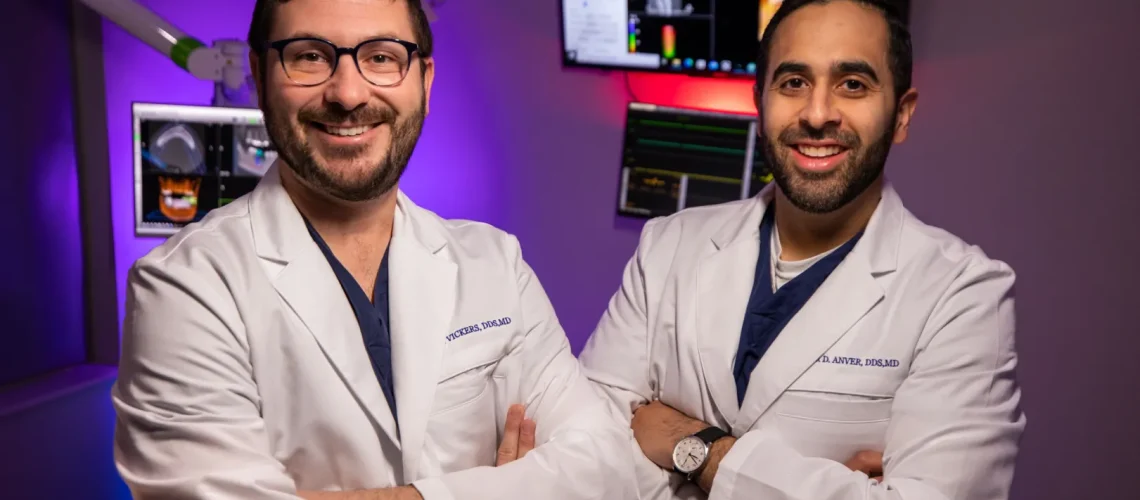
At Texas Center for Oral Surgery & Dental Implants, every implant case is led by a board-certified oral and maxillofacial surgeon. The surgeons at Texas Center place implants daily, treat full-arch cases routinely, and bring the full depth of surgical and anesthesia training that implant patients deserve.
If you are considering dental implants in the Dallas-Fort Worth area, we invite you to schedule a consultation and experience the difference that surgeon-led care makes.